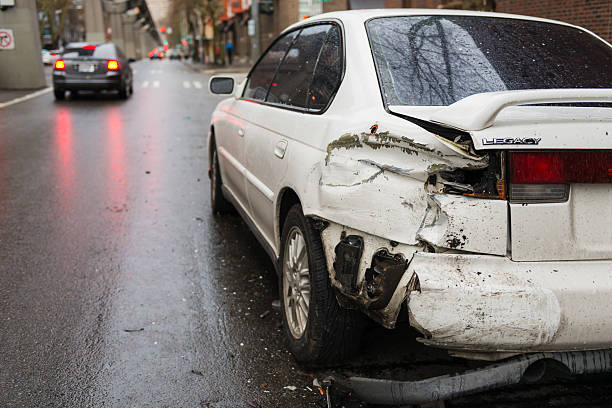

You would think that determining fault in a parking lot crash would be simple. It is not. Parking lots are chaotic spaces where normal traffic rules do not always apply, and drivers often make split-second decisions that lead to fender benders, dented doors, and contested insurance claims. Unlike a highway or a city street, there are no traffic lights, no clear lanes, and in many cases, no police officer who will even bother to write a report. That leaves fault determination in the hands of insurance adjusters who have to piece together what happened from conflicting stories, grainy surveillance footage, and the physical damage to the vehicles.
The biggest mistake people make is assuming that the driver who is moving always has the right of way. That is not true. In a parking lot, drivers in a through lane generally have the right of way over vehicles backing out of a space. But that does not mean the moving driver is never at fault. If a moving driver is speeding through a parking lot, ignoring stop signs posted near the entrances, or driving distracted while looking for a spot, they can be held partially or fully responsible for a crash. The real standard is not a rigid rule but a simple question: Which driver acted negligently? That means did either driver fail to act with the reasonable care that any ordinary person would use in that situation.
Consider the most common parking lot collision: one driver backs out while another driver is passing behind. In most cases, the backing driver is at fault because they have the duty to yield to any traffic that is already moving in the aisle. But if the passing driver was going well above the posted speed limit for a parking lot, or if they were weaving between rows to beat traffic, the fault can shift. Insurance companies do not look at these incidents as either-or. They look at percentages. In a state with comparative negligence, which is the rule in most of the country, each driver can be assigned a share of the blame. If you are found to be twenty percent at fault, your compensation for damages is reduced by twenty percent. If you are fifty percent or more at fault, you may recover nothing at all in some states. That is why it is critical to understand that a parking lot crash does not automatically mean the other driver pays for everything.
Another tricky scenario involves cars that are parked legally. If a parked car gets hit by a moving car, the moving car is almost always at fault. That seems straightforward. But what if the parked car’s door was opened into the path of the moving car? Then the person opening the door is at fault because they have a duty to check for oncoming traffic. What if the parked car was straddling two spaces or parked in a fire lane? Then the parked car’s driver may be partially at fault for creating a hazard. These details matter more than you might think, especially when the damage is minor but the repair costs still run into the thousands.
The biggest practical problem with parking lot crashes is the lack of official documentation. Police in many jurisdictions will not respond to a parking lot accident unless someone is injured or a vehicle is disabled. That means there is no police report to tell the insurance company who was at fault. Instead, the adjuster will rely on your account, the other driver’s account, and any evidence you can gather. If you do not have photos of the damage, the positions of the cars, and any visible skid marks, you are at the mercy of the other driver’s version of events. Witnesses help, but people in parking lots are often in a hurry and will not stick around. That is why you should take pictures with your phone immediately, including wide shots that show the layout of the parking lot and close-ups of the damage. Ask nearby drivers if they saw anything and offer to exchange contact information. If a nearby business has security cameras, point that out to the police and to your insurance company.
One more thing to understand: your own insurance company is not on your side in a fault determination. Their job is to minimize their payout. If you file a claim, they will scrutinize your story for gaps. If the other driver’s insurance company gets involved, the two adjusters will negotiate over fault percentages. In parking lot accidents, they often end up splitting the blame evenly because the evidence is so thin. That means each driver’s insurance covers their own driver’s damage, and both drivers see their premiums go up. Fighting a fifty-fifty split is possible, but it requires evidence that clearly shows the other driver’s negligence. If you do not have that evidence, you may be stuck with the cost of your own repairs, even if you believe the other driver caused the crash.
The bottom line is that fault in a parking lot crash is rarely black and white. It depends on the specific actions of both drivers, the physical layout of the lot, and the quality of the evidence you can gather. Do not assume that being hit means you are automatically entitled to a payout. Do not assume that backing out of a space means you are automatically to blame. The law looks at what each driver reasonably should have done under the circumstances. Your job is to document every detail, report the accident to your insurance company promptly, and be ready to defend your version of events. A little effort at the scene can mean the difference between walking away with a check and walking away with an increased premium and a repair bill.