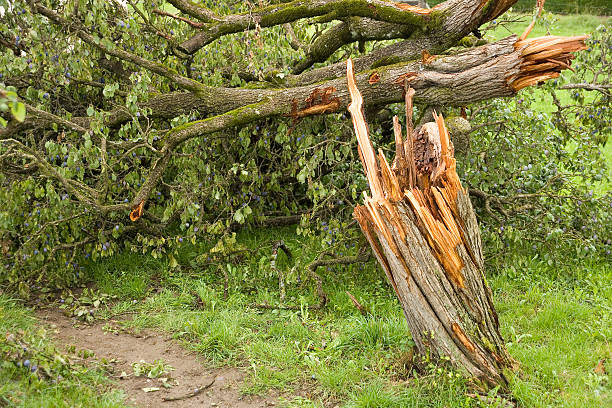
You come home to find a massive oak tree crashed through your roof, or crushed your parked car. A quick look at the street shows skid marks, broken branches, and a mangled guardrail. A driver hit the tree, the tree fell, and the driver kept going. You have no license plate, no name, no face. Now you need to know who is legally responsible for the damage and how to get compensation. The answer depends on where the tree was located, who owned it, and what insurance policies you carry.
The first thing to understand is that the driver who caused the crash is the primary person at fault. In legal terms, they were negligent. They failed to control their vehicle, struck a tree or fixture, and that action led directly to damage to your property. Under normal circumstances, you would file a claim against that driver’s liability insurance. But in a hit-and-run, there is no driver to pursue. That changes everything.
If the tree was on public property, such as a street tree owned by the city or county, you might wonder if the government is liable. The short answer is: almost never. Governments have legal immunity for most roadside trees unless they had specific warning that the tree was unstable before the crash. A driver hitting a healthy tree does not make the government responsible. The tree was not defective; it was just in the wrong place at the wrong time. You cannot sue the city simply because a hit-and-run driver crashed into one of their trees.
If the tree was on private land owned by a neighbor, the same logic applies. A property owner is not liable for damage caused when a third party—the hit-and-run driver—crashes into their tree. The owner did nothing wrong. They did not plant the tree in the road. They did not cause the collision. Unless you can prove the tree was already dead or dangerous and the driver’s crash was merely the final straw, the neighbor owes you nothing. That kind of proof is extremely difficult to gather after a hit-and-run.
That leaves you with one real source of money: your own insurance policy. The type of coverage that applies depends on whether the tree damaged your vehicle or your home.
For a vehicle that was parked on your property or on the street, you need uninsured motorist property damage coverage, often called UMPD. This is an optional coverage in many states. It pays for damage to your car when the at-fault driver is unknown or uninsured. If you have this coverage, your insurance company will treat the hit-and-run crash as if the other driver had insurance. You pay your deductible, and the insurer covers the rest up to your policy limits. If you do not have UMPD, you may still have collision coverage. Collision covers damage to your car from any impact, including a falling tree caused by a collision. But collision is not designed to handle hit-and-run situations without the other driver’s information, and it often comes with a higher deductible. Review your policy carefully.
For damage to your house or other structures, you need homeowners insurance. A tree that falls onto your roof after being hit by a car is typically covered under the “falling objects” or “vehicle collision” peril in a standard homeowners policy. Most policies cover damage from a vehicle, even if the driver is unknown. You will need to file a claim, pay your deductible, and provide evidence that the tree fell because of the crash. The insurance company may send an adjuster to inspect the scene and confirm the cause. They will also want a police report documenting the hit-and-run.
Police reports are critical. You must call the police immediately, even if the driver is gone. The report will serve as official documentation that the accident occurred and that the driver fled. Without a report, your insurance company may deny the claim or classify the damage as an “act of God,” which is often excluded. A falling tree from a storm is not covered. A falling tree from a car crash is covered. The police report makes that distinction.
What about the tree itself? If the tree was on your own property and the hit-and-run driver crashed into it, you might have to pay to remove the damaged tree. Most home insurance policies do not cover tree removal unless the tree is blocking a driveway or has fallen on a structure. A tree that is split but still standing is your responsibility. Similarly, if the tree was on public property, the city may remove the hazard, but you will likely have to wait. You can try to bill the city, but as explained earlier, they will almost certainly refuse.
There is also the possibility of a third-party claim if the hit-and-run driver is eventually caught. Even years later, if the police identify the driver, you can pursue them for the full amount of your loss, including your deductible, tree removal costs, and any other expenses not covered by insurance. But do not count on this. Most hit-and-run cases go unsolved.
Your best move is to act immediately. Document the scene with photos of the tree, the road, the skid marks, and the damage to your property. Get a police report. Contact your insurance agent and ask specifically whether you have uninsured motorist property damage coverage and whether tree removal is included. Understand that your premiums may increase after filing a claim, but that is usually preferable to paying thousands out of pocket.
In short, when a hit-and-run driver knocks a tree onto your property, the responsible party is almost always your own insurance company—not the driver, not the city, not the neighbor. The sooner you start the claims process, the sooner you can get your property repaired.