The unsettling crash of a fallen tree is often followed by a more complicated question: who pays for the damage? When a tree from your property falls and damages your neighbor’s house, determining liability is not always straightforward. The answer generally hinges on a critical legal distinction between an “act of God” and negligence, making the tree owner’s responsibility largely dependent on what they knew, or should have known, about the tree’s condition prior to the event.
In most jurisdictions, if a healthy tree falls due to a sudden, unexpected, and unpreventable natural event—such as an extraordinary storm, a lightning strike, or a hurricane—it is considered an “act of God.“ In these circumstances, the property owner where the tree stood is typically not held legally liable for the damage. The reasoning is that no one could have reasonably foreseen or prevented the incident. Therefore, the neighbor whose house was damaged would file a claim with their own homeowner’s insurance policy to cover the repairs. This principle places the burden of protecting one’s own structures on the property owner, assuming the tree was sound.
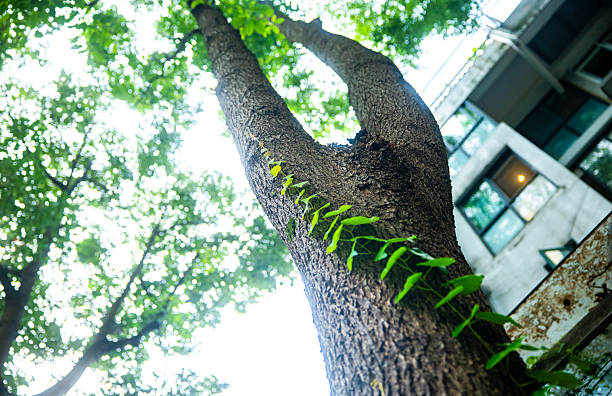
However, liability shifts decisively if the tree owner was negligent. Negligence arises when a reasonable person would have recognized that the tree posed a danger and failed to take appropriate action. This is known as “premises liability.“ If the tree was visibly dead, diseased, rotted, or structurally compromised, and the owner knew or should have known about its hazardous condition, they can be held responsible for the resulting damage. Evidence of negligence might include prior warnings from the neighbor, an arborist’s report, visible fungal growth, significant dead branches, or a pronounced lean. In such cases, the tree owner’s homeowner’s insurance liability coverage would typically handle the claim, covering the costs to repair the neighbor’s property and potentially remove the tree.
The situation grows more complex when the tree is located directly on a property line. In many areas, trees straddling a boundary are considered common property, meaning both neighbors share responsibility for its maintenance and any damage it causes. Both parties’ insurance policies may become involved, and cooperation is essential. Furthermore, if a neighbor had previously expressed concern about a hazardous tree and the owner ignored it, that documented warning significantly strengthens a negligence claim. Proactive communication is not just neighborly; it is a crucial part of risk management. Even if a tree appears healthy, regular inspections, especially after severe weather, are a prudent practice to demonstrate reasonable care.
Ultimately, while the immediate impulse may be to assign blame, the practical resolution almost always involves insurance companies. The affected neighbor should promptly document the damage with photographs and contact their insurer. Their company will then investigate the cause of the fall. If evidence of the tree owner’s negligence is found, the neighbor’s insurer may seek reimbursement, a process called subrogation, from the tree owner’s insurance provider. This legal and financial process underscores why maintaining healthy trees and addressing known hazards is not merely a matter of arboriculture but one of legal and financial responsibility.
Therefore, responsibility in these distressing events is not automatically assigned by the location of the tree’s roots, but by the root cause of its fall. A healthy tree felled by a freak storm is a shared misfortune resolved through personal insurance. A rotten tree ignored until it crashes through a roof is a failure of duty for which the tree owner is accountable. The key for every property owner is to exercise reasonable care—regularly inspecting trees, heeding obvious signs of decay, and seeking professional evaluations when in doubt. In doing so, one protects not only their neighbor’s home but also themselves from significant liability, fostering safer and more harmonious communities.